

Understanding Water Guided Laser Technology: A New Era of Precision Cutting
With the rapid development of advanced industries such as medical devices, aerospace, semiconductor manufacturing, and energy, the performance requirements for critical components continue to increase. This demand has accelerated the evolution of precision machining technologies and equipment.
In these high-value manufacturing sectors, selecting the right cutting technology is essential to achieving superior product quality, reliability, and performance.
Traditional machining methods, including mechanical cutting and high-pressure waterjet cutting, have been widely used for decades. However, laser cutting technology has gradually become a preferred solution due to its advantages in processing efficiency, precision, flexibility, and environmental sustainability.
By using a high-energy laser beam to directly remove material, laser cutting enables highly accurate and efficient processing without physical contact between the tool and the workpiece. This reduces mechanical stress and supports cleaner, greener manufacturing processes.
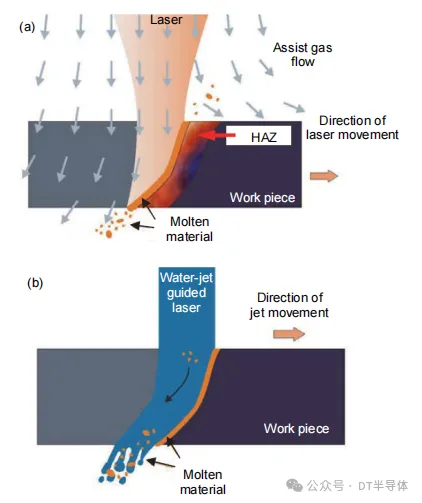
However, conventional laser cutting still faces limitations in certain precision applications, especially when processing heat-sensitive materials. Thermal effects may create a heat-affected zone (HAZ), surface oxidation, micro-cracks, and recast layers, which can negatively impact component performance and service life.
To overcome these challenges, Water Guided Laser technology was developed as an advanced hybrid laser processing method. By combining laser energy with a high-precision water jet, it significantly reduces thermal damage while improving edge quality and machining accuracy.
A water guided laser, also known as a water jet guided laser, uses a thin, high-speed water jet to guide a laser beam during precision machining.
Water Guided Laser (WGL) is an innovative hybrid machining technology that uses a fine water jet to guide and transmit a laser beam onto the workpiece surface for precision cutting.
The core principle of this technology is based on the difference in refractive index between water and air. When a laser beam enters the water-air interface at an appropriate angle, total internal reflection occurs, allowing the laser energy to remain confined within the water jet and be efficiently transmitted over a long distance.
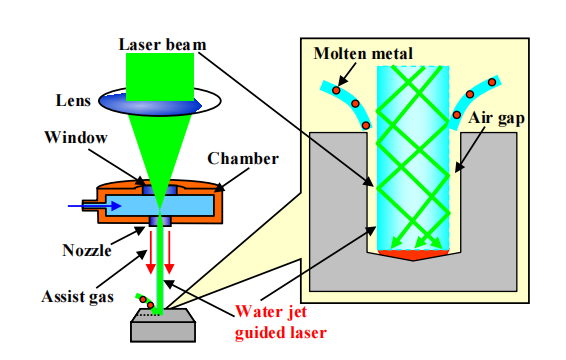
The laser beam is first focused through an optical lens and then passes through a quartz window into the coupling chamber. By precisely adjusting the distance between the focusing lens and the micro-nozzle, the laser focus is accurately positioned at the center of the nozzle outlet.
The focused laser beam then enters the stable water jet. Due to the refractive index difference between water and air, the laser is guided inside the water stream in a similar way to light transmission inside an optical fiber.
During machining, the high-pressure water jet acts as a flexible optical waveguide, delivering the focused laser energy directly to the material surface and enabling high-precision cutting with excellent edge quality.
Water Guided Laser combines the advantages of laser processing and waterjet technology, making it especially suitable for precision manufacturing and micro-machining applications.
Compared with conventional laser cutting, Water Guided Laser provides several unique advantages:
1. Minimal Thermal Damage
One of the most significant advantages of Water Guided Laser is its ability to minimize thermal effects.
Traditional laser cutting generates high temperatures that may cause:
-
Material deformation
-
Microstructural changes
-
Oxidation
-
Heat-affected zones
In Water Guided Laser processing, the surrounding water flow continuously cools the cutting area, especially during laser pulse intervals. This effectively reduces thermal stress and helps maintain the original physical and chemical properties of the material.
2. Superior Cutting Quality and Precision
The water-guided laser beam provides a longer working distance and does not require extremely precise focusing conditions like conventional laser systems.
This offers greater flexibility when processing:
-
Complex geometries
-
Thin-wall components
-
Precision microstructures
-
Difficult-to-machine materials
As a result, Water Guided Laser achieves excellent dimensional accuracy and surface quality.
3. Cleaner Processing Environment
During cutting, the water stream performs multiple functions:
-
Cooling the processing zone
-
Removing molten material
-
Reducing debris accumulation
-
Improving surface cleanliness
This makes Water Guided Laser particularly suitable for industries requiring high cleanliness standards, including:
-
Semiconductor manufacturing
-
Medical devices
-
Precision components
4. Ideal for Thin and Delicate Materials
Because Water Guided Laser enables controlled material removal with extremely low thermal influence, it is highly suitable for processing thin and fragile components.
Compared with traditional laser machining, it delivers:
-
Higher edge quality
-
Reduced micro-cracking
-
Improved product reliability
-
Higher manufacturing yield
With continuous technological advancement, Water Guided Laser is expected to become an important alternative to conventional laser cutting in many advanced manufacturing fields.
Although Water Guided Laser technology offers significant advantages, several technical challenges remain before wider industrial adoption.
1. Laser Energy Attenuation in Water
One major challenge is laser energy loss during transmission through the water jet.
High-power laser beams experience attenuation caused by:
-
Optical scattering
-
Energy absorption
-
Beam transmission losses
This can reduce machining efficiency, especially when processing thicker materials.
For example, when cutting an 18 mm carbon fiber composite material, processing speed may be limited to approximately 5 mm/min, restricting applications in heavy material processing.
Future developments may focus on improving optical transmission efficiency and exploring alternative guiding media with better laser propagation characteristics.
2. Challenges in Micro Water Jet Formation
The diameter of the water jet directly affects cutting precision and kerf width.
Current nozzle technology can achieve water jet diameters of approximately 30 μm, enabling high-precision machining.
However, further miniaturization requires solving challenges related to:
-
Water jet stability
-
Effective jet length
-
Laser spot control
-
Fluid dynamics optimization
Future research will focus on advanced nozzle structures and optimized fluid control technologies.
3. High Precision Requirements for Nozzle Manufacturing
The nozzle is one of the most critical components in a Water Guided Laser system.
To achieve stable and precise cutting performance, the nozzle must have:
-
Extremely thin wall thickness
-
High roundness accuracy
-
Nearly zero taper
-
Ultra-smooth internal surface finish
These requirements make nozzle manufacturing highly challenging, especially for mass production where consistency and reliability are essential.
4. Complexity of Laser-Water Beam Coupling and Alignment
The coupling accuracy between the laser beam and water jet directly determines machining quality.
Although modern systems use high-precision servo control mechanisms, achieving fast and accurate laser-water alignment remains technically challenging.
Future systems will require advanced technologies such as:
-
Optical coupling monitoring systems
-
Water-guided laser alignment detection
-
Automatic calibration systems
-
High-precision positioning platforms
These technologies are essential for achieving stable industrial-scale precision machining.
5. Need for Systematic Process Development
Although Water Guided Laser has demonstrated excellent technical advantages, process optimization remains a key challenge.
Currently, the industry still lacks:
-
Comprehensive process databases
-
Standardized evaluation methods
-
Universal machining parameters
This limits application flexibility across different materials and thickness ranges.
Future development will require systematic research to establish complete process parameter libraries and evaluation standards, enabling broader industrial adoption.
Water Guided Laser represents a new generation of precision laser processing technology that combines the advantages of laser accuracy and water cooling capability.
By significantly reducing thermal damage while improving cutting quality and cleanliness, it provides an advanced solution for demanding applications in:
-
Semiconductor manufacturing
-
Medical devices
-
Aerospace components
-
Precision engineering
-
Advanced materials processing
As technology continues to mature, Water Guided Laser is expected to play an increasingly important role in next-generation intelligent and high-precision manufacturing.


