

Water Guided Laser Technology Emerges as a New Industry Breakthrough as Watlaser Secures Angel Financing
Shanghai Watlaser Technology Co., Ltd. has successfully secured an angel investment of tens of millions of RMB, with the round led exclusively by Kaifeng Venture Capital.
The funding will primarily support the research, development, and commercialization of advanced Water Guided Laser equipment.
Founded in February 2023, Watlaser focuses on the development
and manufacturing of Water Guided Laser systems. Its two co-founders are graduates of the University of Science and Technology of China and Tsinghua University, respectively, and both have held senior management positions at publicly listed companies.
With more than 10 years of experience in laser processing, waterjet cutting, core hardware, and CNC control systems, the company has built a highly R&D-oriented team, with R&D personnel accounting for approximately 90% of its workforce.
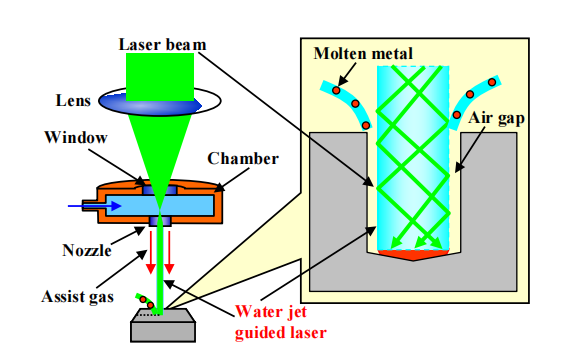
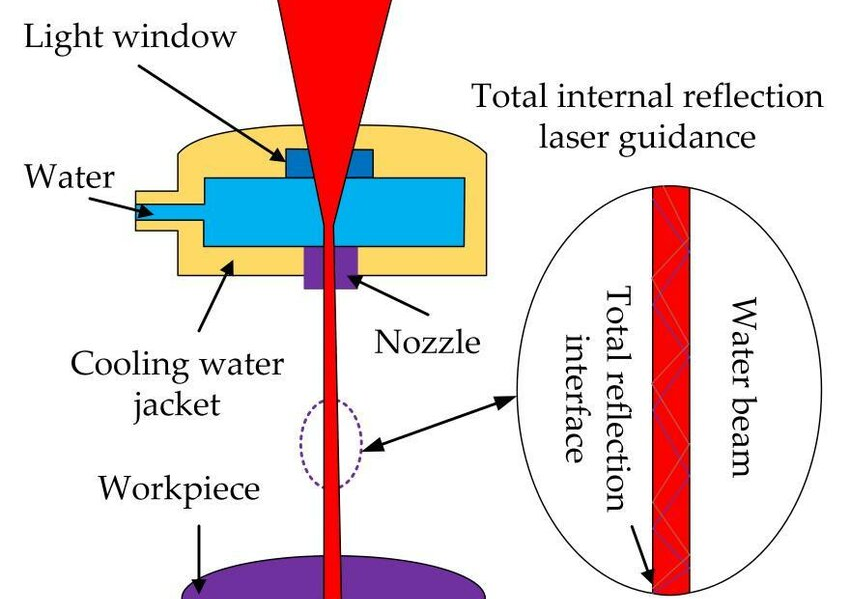
Water Guided Laser is an advanced laser-based cold processing technology that uses a high-pressure micro water jet as an optical waveguide.
Through precision optical coupling, the laser beam is introduced into the micro water jet and guided along the water column by total internal reflection. The laser is then delivered precisely to the workpiece surface for high-precision material processing.
Water Guided Laser Processing Principle
Unlike conventional laser processing, Water Guided Laser combines laser energy with the cooling effect of a high-speed water jet.
During processing, the water continuously cools the workpiece and removes heat from the machining zone. This significantly reduces the heat-affected zone and thermal damage, while improving dimensional accuracy and surface quality.
The technology can also reduce processing time and material waste, making it particularly attractive for precision manufacturing applications.
Water Guided Laser technology can process a wide range of materials, including high-strength, high-temperature, highly viscous, and porous materials.
Its potential applications include:
-
Semiconductor wafer dicing
-
Precision alloys
-
Aerospace components
-
Synthetic diamond
-
Medical devices
-
New energy materials
-
Smart grid components
-
Electronic manufacturing
As advanced materials continue to evolve, manufacturers are facing increasingly difficult processing challenges.
The development of third-generation and next-generation semiconductor materials is a typical example. Materials such as silicon carbide (SiC) offer excellent physical properties but are significantly harder and more difficult to machine than conventional semiconductor materials.
This creates an urgent need for new manufacturing technologies.
A new generation of materials requires a new generation of processing tools.
With its combination of precision, efficiency, and minimal thermal impact, Water Guided Laser technology has significant potential for advanced semiconductor processing and may become an important part of the future semiconductor manufacturing equipment ecosystem.
In recent years, the demand for Water Guided Laser equipment has continued to grow alongside the rapid development of advanced materials.
The technology is particularly promising for applications where conventional machining and traditional laser processing face limitations, such as:
-
Thermal damage
-
Heat-affected zones
-
Microcracks
-
Edge chipping
-
Material deformation
-
Difficult-to-machine materials
By combining laser precision with water cooling, Water Guided Laser provides a new approach to high-precision processing of advanced materials.
For many years, Water Guided Laser technology and its commercialization have been dominated by specialized international companies, resulting in relatively high equipment costs.
Watlaser is working to accelerate the localization and independent development of Water Guided Laser equipment.
According to co-founder Wei Wang, the independent development and integration of core software and hardware are essential for technology-intensive equipment.
Watlaser is not simply following an emerging trend. Its technology is built on more than a decade of experience in both laser processing and waterjet cutting.
These two areas of expertise converge naturally in Water Guided Laser technology.
Today, key components such as the laser-water coupling head and the CNC control system are developed independently by Watlaser.
Building on its team's technical expertise, Watlaser completed the development of its experimental Water Guided Laser system within just six months.
The company has already completed initial processing tests on:
-
Diamond materials
-
Silicon carbide (SiC)
-
Other advanced engineering materials
These early results demonstrate the potential of Water Guided Laser technology for challenging material processing applications.
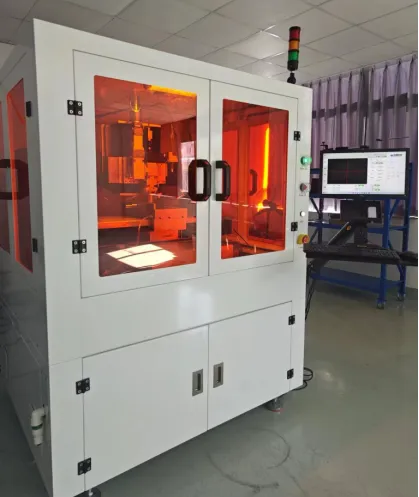
According to Chen Yu, co-founder and CEO of Watlaser, the company's primary commercialization objective is to launch a fully localized Water Guided Laser system within one year.
The goal is to make this emerging laser processing technology accessible to a broader range of downstream industries and accelerate its adoption in advanced material processing.
As the localization of Water Guided Laser equipment continues to advance, Chinese technology companies such as Watlaser have the potential to help reduce dependence on imported equipment while lowering overall processing costs.
This could open up new opportunities for large-scale adoption across semiconductor materials, advanced manufacturing, aerospace, medical devices, and other high-end industries.
Watlaser will continue to focus on the research and development of Water Guided Laser technology, with the goal of delivering high-performance, reliable, and cost-effective processing solutions for advanced materials.
By combining independently developed CNC systems, core hardware, and Water Guided Laser technology, Watlaser is working to accelerate the industrialization of next-generation material processing.
Water Guided Laser is not simply a new way to cut materials — it is a new approach to precision manufacturing.


