

Water Guided Laser vs. Waterjet Cutting: Key Differences Engineers Need to Know
Waterjet cutting and Water Guided Laser (WGL) technology both use water during the machining process, but they are fundamentally different technologies.
For engineers and manufacturers working with advanced materials, understanding these differences is essential when selecting the right processing solution for precision cutting, micro-machining, and high-value components.
Waterjet Cutting
Waterjet cutting uses an ultra-high-pressure water stream, often mixed with abrasive particles, to mechanically remove material.
The cutting process relies primarily on the mechanical impact and erosion of the high-pressure jet.
This makes waterjet cutting suitable for a wide range of materials, including metals, stone, glass, and composites.
Water Guided Laser
Water Guided Laser technology combines a laser beam with a fine, high-speed water jet.
The laser beam is coupled into the micro water column and guided through the water by total internal reflection.
The water column acts as a flexible optical waveguide while simultaneously cooling the machining area and removing processing debris.
This enables highly precise, low-thermal-damage machining.

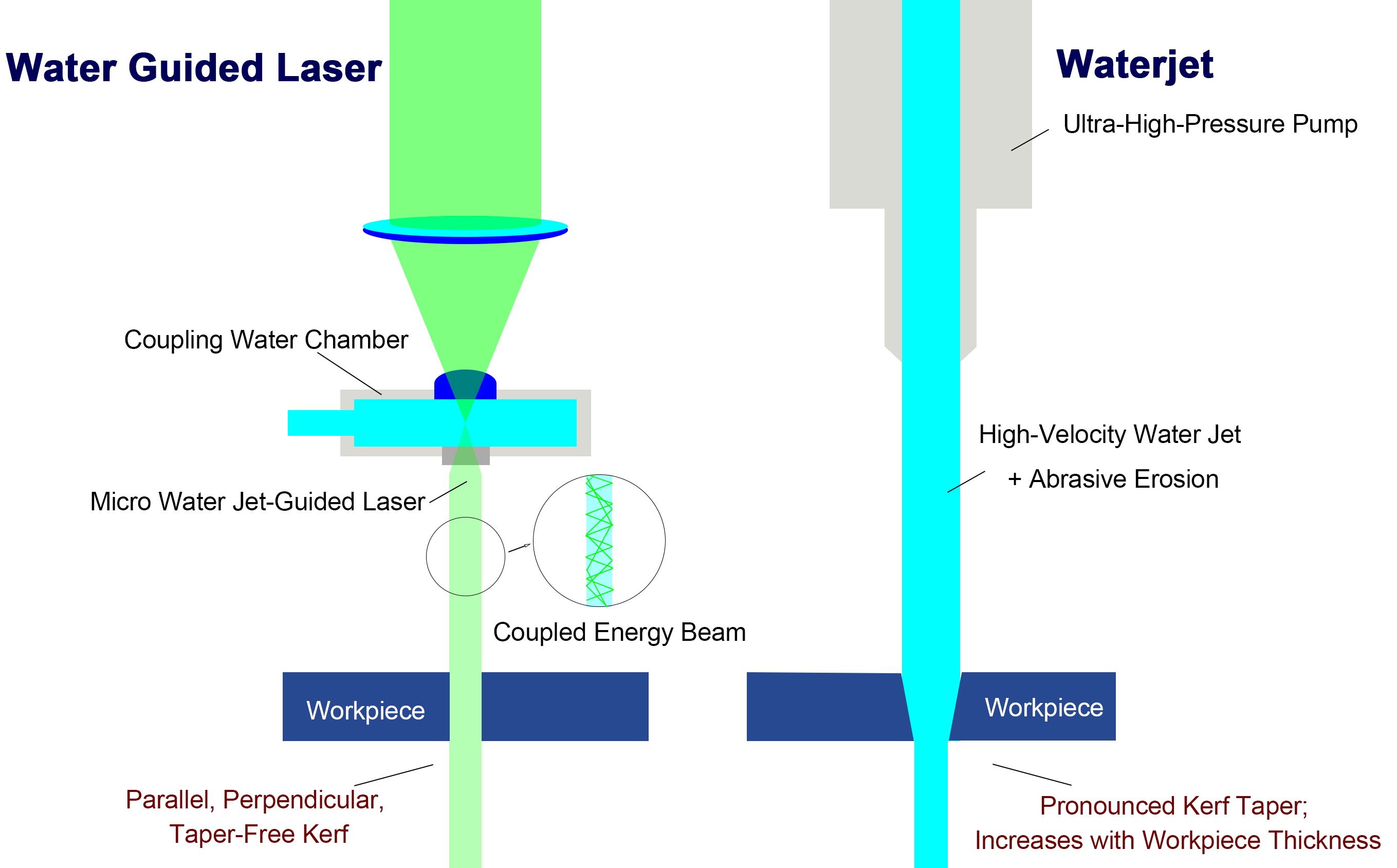
The fundamental difference lies in how material is removed.
Waterjet:
Material is removed through mechanical erosion caused by an ultra-high-pressure water stream.
Water Guided Laser:
Material is removed through laser-material interaction, while the water jet guides the laser and provides continuous cooling.
As a result, the two technologies have very different capabilities in terms of precision, thermal effects, feature size, and surface quality.
Waterjet cutting is highly effective for general-purpose cutting, but its process characteristics limit its ability to produce extremely small features and high-precision microstructures.
Water Guided Laser technology is designed for precision machining.
Its fine laser beam and small interaction zone enable the processing of:
-
Micro holes
-
Micro grooves
-
Thin-walled structures
-
Precision slots
-
Complex contours
-
High-aspect-ratio structures
For high-value components where dimensional accuracy and edge quality are critical, WGL can provide significant advantages over conventional waterjet cutting.
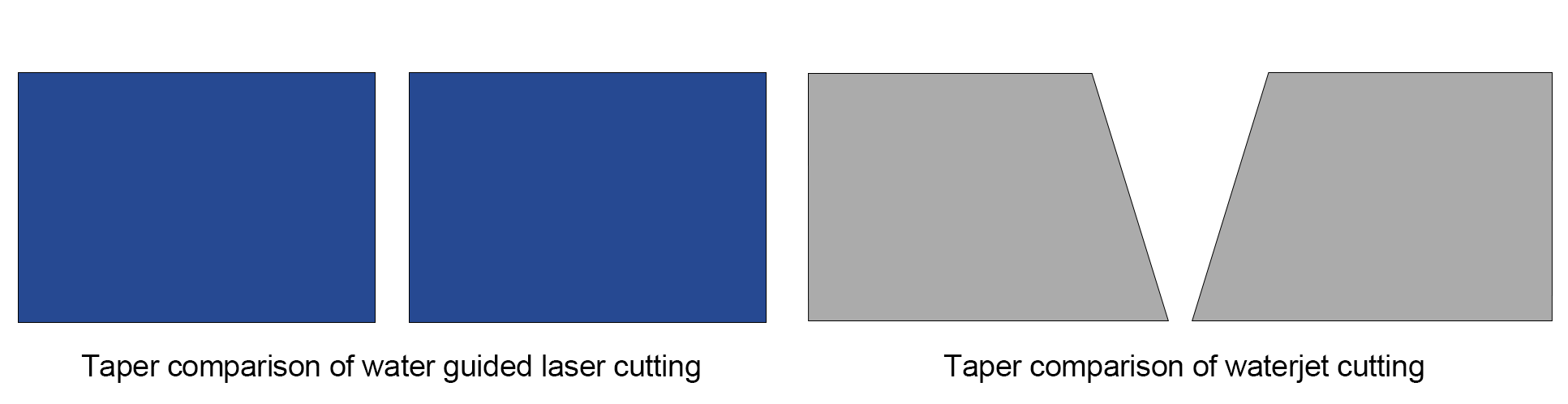
Waterjet cutting can produce good cutting quality, but the process may generate taper, surface texture, or edge effects depending on material thickness, abrasive conditions, and process parameters.
Water Guided Laser can achieve highly precise and relatively smooth cutting surfaces with minimal thermal damage.
For difficult-to-machine materials, this can help reduce:
-
Edge chipping
-
Cracking
-
Recast layers
-
Burrs
-
Thermal deformation
-
Secondary finishing requirements
This is particularly important for semiconductor, aerospace, medical, and precision manufacturing applications.
Both technologies can process a wide range of materials, but their strengths are different.
Waterjet Cutting
Waterjet is well suited for:
-
Stainless steel
-
Aluminum
-
Titanium
-
Glass
-
Stone
-
Composites
-
General industrial materials
Water Guided Laser
WGL is particularly valuable for difficult-to-machine and high-value materials such as:
-
Silicon carbide
-
Diamond
-
Diamond copper
-
Advanced ceramics
-
Tungsten steel
-
Titanium alloys
-
Precision metal components
-
Composite materials
For materials where heat, stress, cracking, or edge damage are major concerns, Water Guided Laser can offer a more specialized solution.
Waterjet remains an excellent choice when:
-
Large parts need to be cut
-
Material thickness is relatively high
-
Cutting geometry is relatively simple
-
Extremely high precision is not required
-
Mechanical cutting is acceptable
-
A cost-effective general-purpose cutting process is needed
For these applications, waterjet technology offers versatility and strong cutting capability.
Water Guided Laser becomes more attractive when the application requires:
-
High dimensional accuracy
-
Minimal thermal damage
-
Minimal edge chipping
-
Micro-hole or micro-groove machining
-
High-aspect-ratio structures
-
Thin-wall processing
-
Complex precision geometries
-
High-quality cutting surfaces
-
Processing of hard and brittle materials
In advanced manufacturing, the key advantage of WGL is not simply cutting faster—it is enabling processing that conventional technologies may struggle to achieve.

| Feature | Waterjet Cutting | Water Guided Laser |
|---|---|---|
| Processing principle | Mechanical erosion | Laser-material interaction |
| Water function | Cutting medium | Laser waveguide + coolant |
| Thermal damage | Very low | Extremely low |
| Micro-machining | Limited | Excellent |
| Micro holes / grooves | Limited | Excellent |
| Edge quality | Good | Excellent |
| Hard & brittle materials | Good | Excellent |
| High-aspect-ratio structures | Limited | Strong capability |
| Precision machining | Good | High precision |
| Typical applications | General cutting | Precision & advanced manufacturing |
As semiconductor, aerospace, medical, energy, and advanced manufacturing industries continue to demand higher precision and better material performance, conventional machining technologies are facing increasing limitations.
Water Guided Laser provides a new approach by combining:
Laser Precision + Water Cooling + Low Thermal Damage
This combination makes WGL particularly promising for the machining of advanced materials and complex precision structures.
At Watlaser, we focus on developing Water Guided Laser equipment and processing technologies for demanding industrial applications.
Our solutions are designed to help manufacturers improve machining quality, processing consistency, and production efficiency while reducing the risks associated with thermal damage and material deformation.
Waterjet and Water Guided Laser are not simply two different ways of using water for cutting.
They represent two fundamentally different machining principles.
Waterjet focuses on high-pressure mechanical cutting.
Water Guided Laser combines laser precision with the cooling and guiding effects of a micro water jet.
For conventional cutting applications, waterjet remains a highly effective solution.
For precision machining, difficult-to-process materials, microstructures, and applications where thermal damage and edge quality are critical, Water Guided Laser offers a powerful alternative.
As advanced materials become increasingly important in semiconductor, aerospace, medical, and high-end manufacturing, Water Guided Laser is opening up new possibilities for precision processing.


