

Water Guided Laser Breaks Through Diamond-Copper Machining Challenges
With the rapid growth of AI high-performance chips, silicon carbide (SiC) power devices, and high-density computing centers, the thermal load of advanced electronic systems continues to increase.
Traditional copper and copper-alloy thermal management materials are approaching their performance limits. Diamond-copper composites, combining ultra-high thermal conductivity, a coefficient of thermal expansion compatible with semiconductor substrates, and lightweight characteristics, are emerging as a promising material for advanced thermal management.
However, diamond copper is extremely challenging to machine. Conventional processes often struggle with cutting, drilling, and slotting, limiting its application in heat sinks, liquid-cooled plates, and other advanced thermal management components.
Water Guided Laser technology offers a new solution to these machining challenges.
1. Diamond Particle Pull-Out
Diamond has extremely high hardness, but its bonding strength with the copper matrix is relatively limited.
Mechanical cutting can generate significant mechanical stress and impact, while conventional laser processing can introduce intense thermal shock. Both can cause diamond particles to detach from the copper matrix, resulting in rough cutting surfaces, severe edge chipping, and even component failure.
Even with Water Guided Laser processing, inappropriate process parameters may still cause diamond particle pull-out.
2. Thermal Damage Can Affect Material Performance
Conventional laser cutting generates a relatively large heat-affected zone.
Excessive heat can cause graphitization of diamond, significantly reducing the thermal conductivity of the material. At the same time, thermal deformation of the copper matrix can make it difficult to maintain dimensional accuracy.
For high-performance thermal management components, minimizing thermal damage is therefore critical.
3. Limited Capability for Thick Diamond-Copper Sheets
Large diamond-copper substrates used in high-power semiconductor devices can be relatively thick.
Conventional laser systems often face limitations in cutting depth and sidewall verticality, making it difficult to achieve stable processing of large and thick workpieces.
This creates additional challenges for precision components that require both high dimensional accuracy and excellent cutting quality.
4. Lack of Mature Solutions for Complex Flow Channels
Liquid-cooled thermal management components increasingly require sophisticated internal flow-channel structures.
Traditional machining methods can suffer from low efficiency and limited precision when processing these complex structures. A mature, scalable solution specifically adapted to diamond copper is still under development.
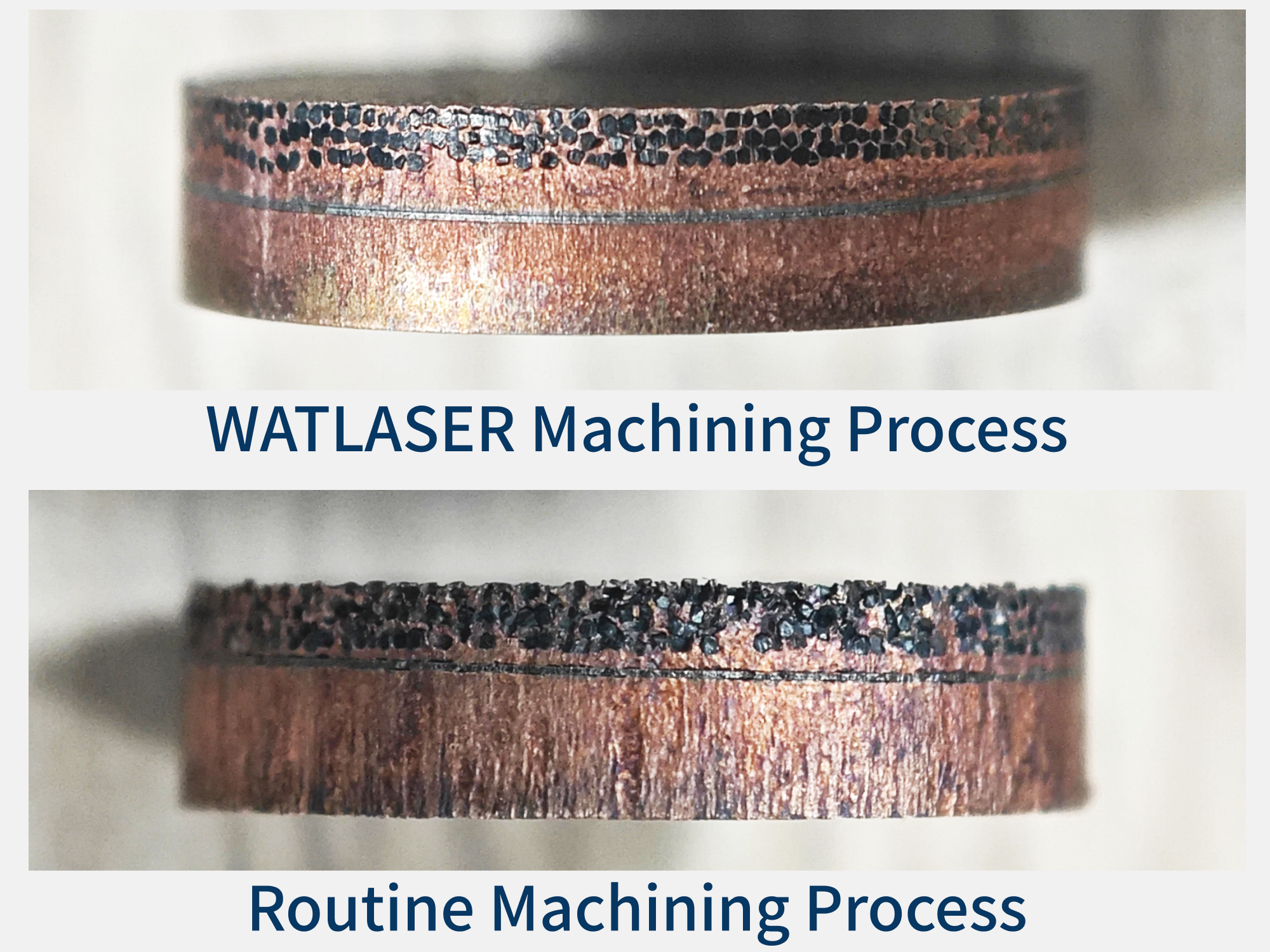
1. Excellent Cutting Quality with Minimal Diamond Particle Loss
Watlaser uses a Water Guided Laser cold-processing approach, in which a high-energy laser beam is guided through a high-pressure micro water jet and precisely delivered to the cutting zone.
The water stream continuously cools the workpiece and removes heat during processing. This dramatically reduces thermal accumulation and helps minimize the risks caused by the significant difference between the melting characteristics of diamond and copper.
As a result, the process can effectively reduce:
-
Diamond particle pull-out
-
Copper matrix deformation
-
Thermal damage
-
Cutting-edge defects
For diamond-copper processing, Watlaser has continuously optimized its process parameters through multiple generations of development.
With the latest process generation, diamond particle loss can be minimized while maintaining a smooth and high-quality cutting surface.
2. Strong Thick-Sheet Cutting Capability
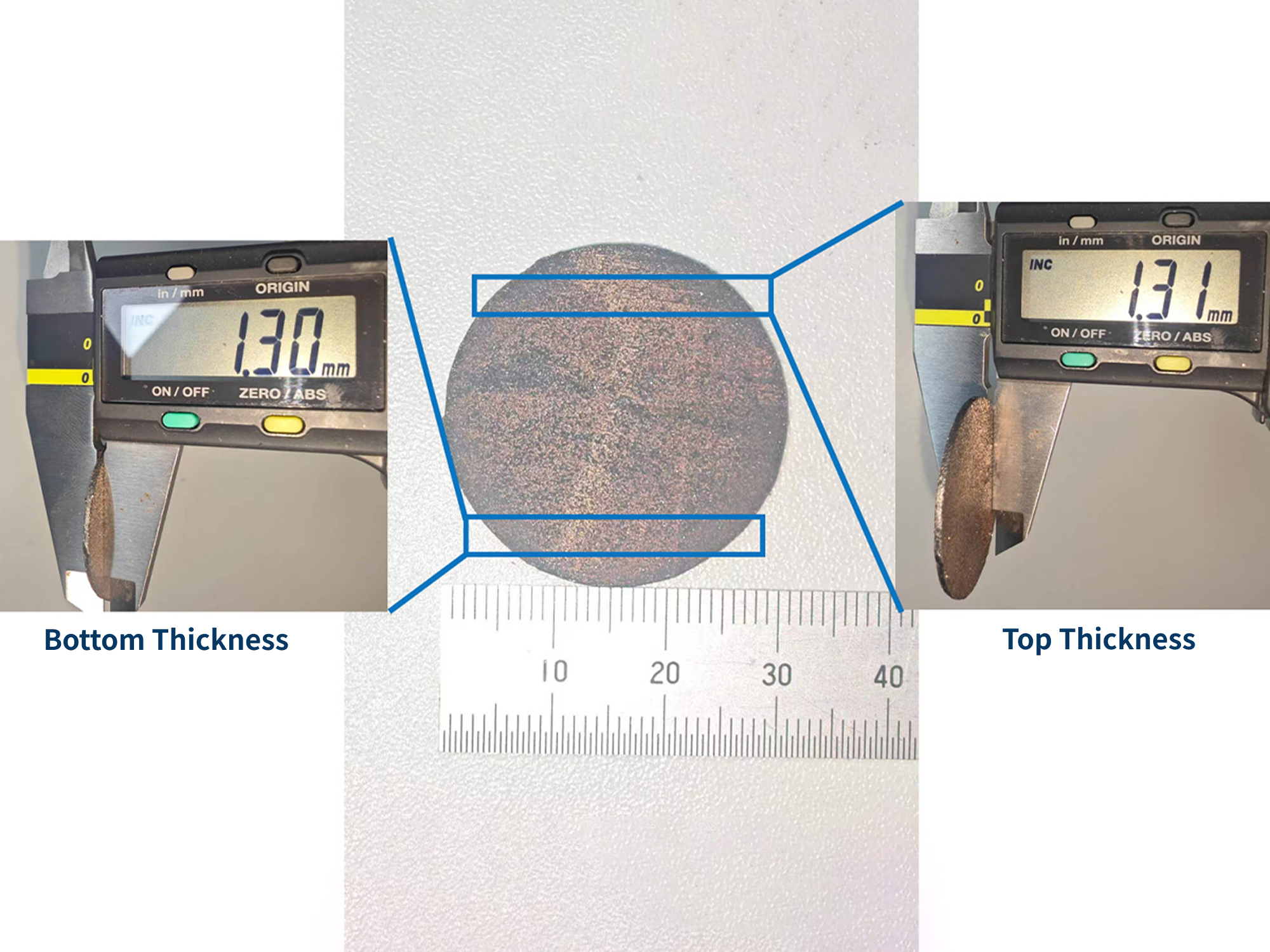
Watlaser's Water Guided Laser systems provide strong cutting-depth capability for diamond-copper materials.
The system can achieve a single-side cutting depth of more than 20 mm, without requiring the workpiece to be flipped.
This capability is particularly valuable when precision components need to be machined directly from larger diamond-copper blanks.
Instead of first producing thin sheets and then machining individual components, manufacturers can cut precision parts directly from larger blanks, potentially improving material utilization and production efficiency.
Watlaser systems can also process thin diamond-copper sheets such as:
15 mm × 15 mm × 0.5 mm
For ultra-thin sheets such as 300 μm or 200 μm, deformation becomes a major challenge during slicing.
Watlaser has accumulated extensive process experience for diamond-copper sheets with different diamond particle sizes and can develop customized slicing solutions according to specific material and dimensional requirements.
3. Next-Generation Technology for Diamond-Copper Flow Channels
As microchannel liquid cooling becomes increasingly important in advanced thermal management, Watlaser is actively developing precision machining processes for diamond-copper flow channels.
The goal is to enable future high-precision, integrated machining of complex flow-channel structures.
This technology will further expand the application potential of diamond copper in advanced thermal management modules and help customers prepare for the next generation of thermal management manufacturing technologies.
Recommended Watlaser Configuration for Diamond-Copper Processing
For most diamond-copper machining applications, Watlaser recommends the WGL3-150 Water Guided Laser system.
Equipped with Watlaser's second-generation laser system, the WGL3-150 provides:
-
Stronger material penetration capability
-
More stable cutting performance
-
Reliable long-duration operation
-
Improved suitability for demanding precision components
The system is particularly suitable for applications involving long continuous machining cycles, including components requiring more than 8 hours of processing time per part.
Diamond copper offers significant advantages for next-generation thermal management, but its unique material structure creates demanding machining requirements.
Watlaser focuses on solving these challenges through a combination of:
Advanced Water Guided Laser equipment + proprietary process development + continuous process optimization
Our solutions cover the full range of diamond-copper machining requirements, from:
With stable equipment performance, accumulated process expertise, and continuous technological innovation, Watlaser helps customers overcome machining bottlenecks and achieve:
for advanced diamond-copper components.


